
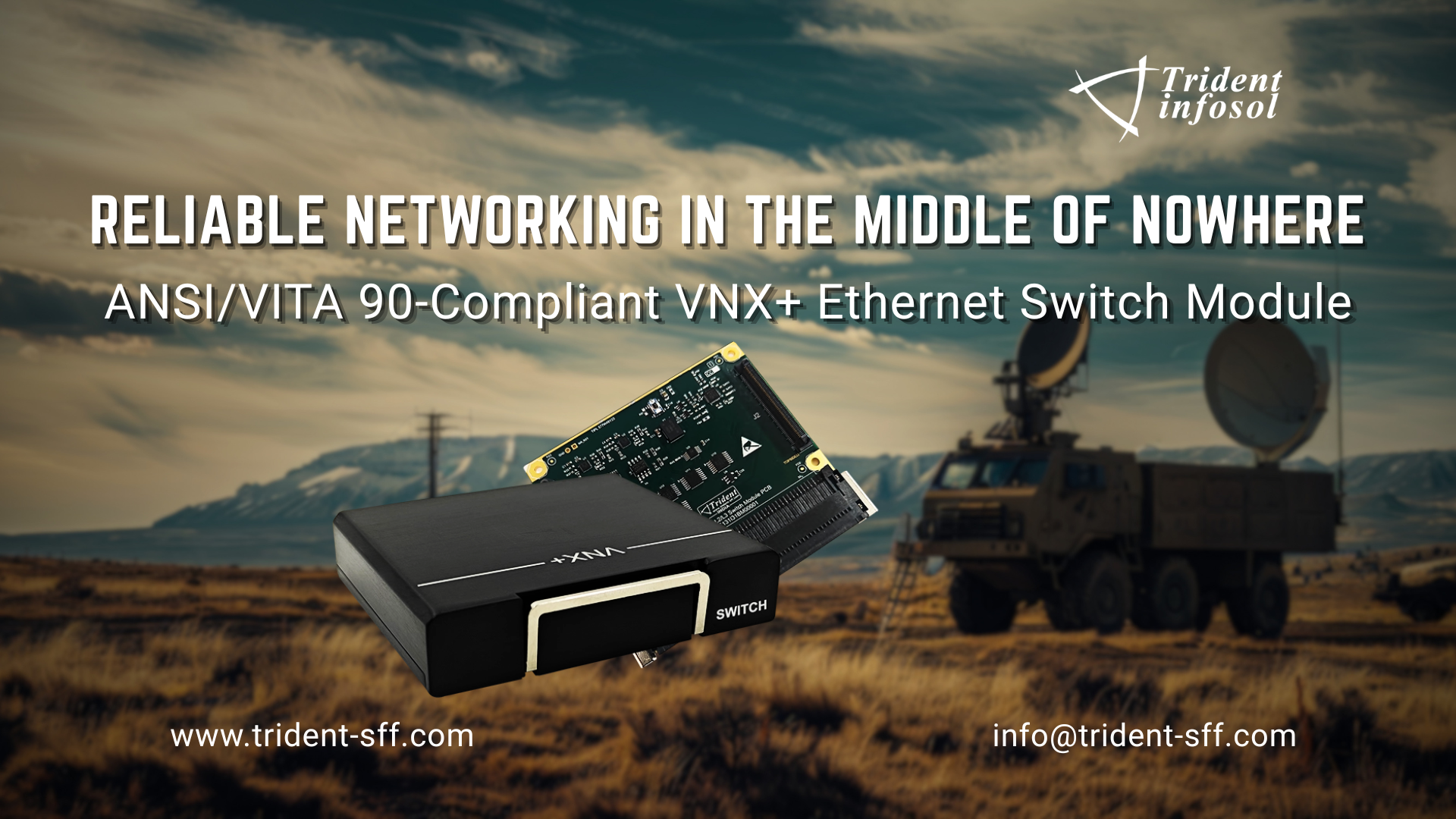
What Is a VNX+ Ethernet Switch: Why It Matters in Rugged Systems
When you design electronics for aerospace, defense, or industrial automation, every decision carries weight—literally. Getting data from one module to another across a rugged embedded system is not simply a matter of plugging in a cable. Networking in these environments demands an infrastructure that can survive vibration, thermal stress, and harsh mission profiles. That is where the Ethernet switch, specifically one built for the VNX+ ecosystem, becomes a critical piece of the rugged architecture. This blog offers an overview of the VNX+ Ethernet Switch and focuses on its reliability, high-speed data connectivity, and standards-compliance.
Understanding the VNX+ Ecosystem
Before we move into what the VNX+ Ethernet Switch is, it is important to understand why it is a crucial component in the VNX+ ecosystem. VNX+ is a small form factor (SFF) open standard for embedded computing modules, governed under the ANSI/VITA 90 framework. It defines how modules are mechanically designed, electrically interconnected, and thermally managed within an integrated system. The power, data, and other signals are all routed through a standardized connector interface, making VNX+ a plug-in friendly platform for mission-critical hardware.
An Ethernet switch module that conforms to this standard sits inside the VNX+ system and acts as the data communication backbone, letting processors, I/Os, and other modules talk to each other and to the data centers in the field.
What a Modular Ethernet Switch Actually Does
At a basic level, an Ethernet switch receives data from one port and forwards them to the correct destination port. Unlike a hub (which blindly broadcasts to everyone) a switch uses MAC addresses so it can route traffic efficiently, reducing congestion and improving throughput.
In a rugged VNX+ switch module context, this same process is packaged into a compact, mechanically robust form factor, operating across a range of power conditions and environmental extremes. It basically has Layer 2 and Layer 3 functionalities that enable proper networking.
Layer 2+ in the VNX+ Switch
Layer 2 functionality handles basic switching tasks:
VLANs (IEEE 802.1Q), Rapid Spanning Tree Protocols (RSTP/MSTP), link aggregation, multicast and broadcast storm control, flooding control, and QoS prioritization across multiple queues. These capabilities reduce network traffic so that time-critical sensor data, for example, always takes priority over other general traffic.
Layer 3+ in the VNX+ Switch
Layer 3 functionality extends the switch’s role into routing, enabling IPv6 static to be routed easily. Support for OSPFv2 dynamic routing also makes it a valuable feature in the module.
Timing, Precision, and Protocol Support
In aerospace and defense applications, time synchronization across a distributed system is the very base factor of how well it performs. IEEE 1588 Precision Time Protocol (PTP) support, available in Layer 3, allows accurate time management. Equally important is the RADIUS accounting for networking, while port and queue policers control the traffic.
Port Density and Expandability
A well-designed rugged Ethernet switch should scale to the application. The eight GigE ports covers most of the network needs. But modular systems are growing, which requires more capacity like the QSGMII expansion interfaces, which allow the switch to support up to 24 ports when an expansion board is added.
Size, Weight, and Power: The Rugged Triangle
SWaP—Size, Weight, and Power—is the defining constraint of embedded defense and aerospace electronics. A VITA 90 Ethernet switch designed for VNX+ ecosystem must therefore be compact, lightweight, and power-efficient, running on power inputs of +3.3 Vdc and +5 Vdc.
Open Standards’ Role in the Modular Ethernet Switch
The ANSI/VITA 90.0 standard ensures that a VNX+ switch module interfaces correctly with the rest of the VNX+ ecosystem—regardless of manufacturer. Using a standard connector to route all I/O and power creates a mechanically and electrically consistent interface across the system.
Key Takeaways
- The VNX+ Ethernet Switch is essential for rugged embedded systems in aerospace, defense, and industrial automation, designed to provide reliable networking in harsh conditions.
- The modular ethernet switch acts as the data communication backbone in the VNX+ system, enabling efficient communication between various modules and data centers.
- It features Layer 2 and Layer 3 functionalities, allowing efficient data routing and management of network traffic, including support for VLANs, IPv4 and IPv6.
- The switch supports IEEE 1588 Precision Time Protocol for precision time synchronization.
- Compliance with VITA 90 open standards ensures compatibility and consistency across the VNX+ ecosystem.
Need Reliable Networking in VNX+ Integrated Systems?
Trident SFF provides plug-in VNX+ ethernet switch module that connects your entire system. For more information, datasheets, and enquiries, contact our team: us-sales@trident-sff.com