
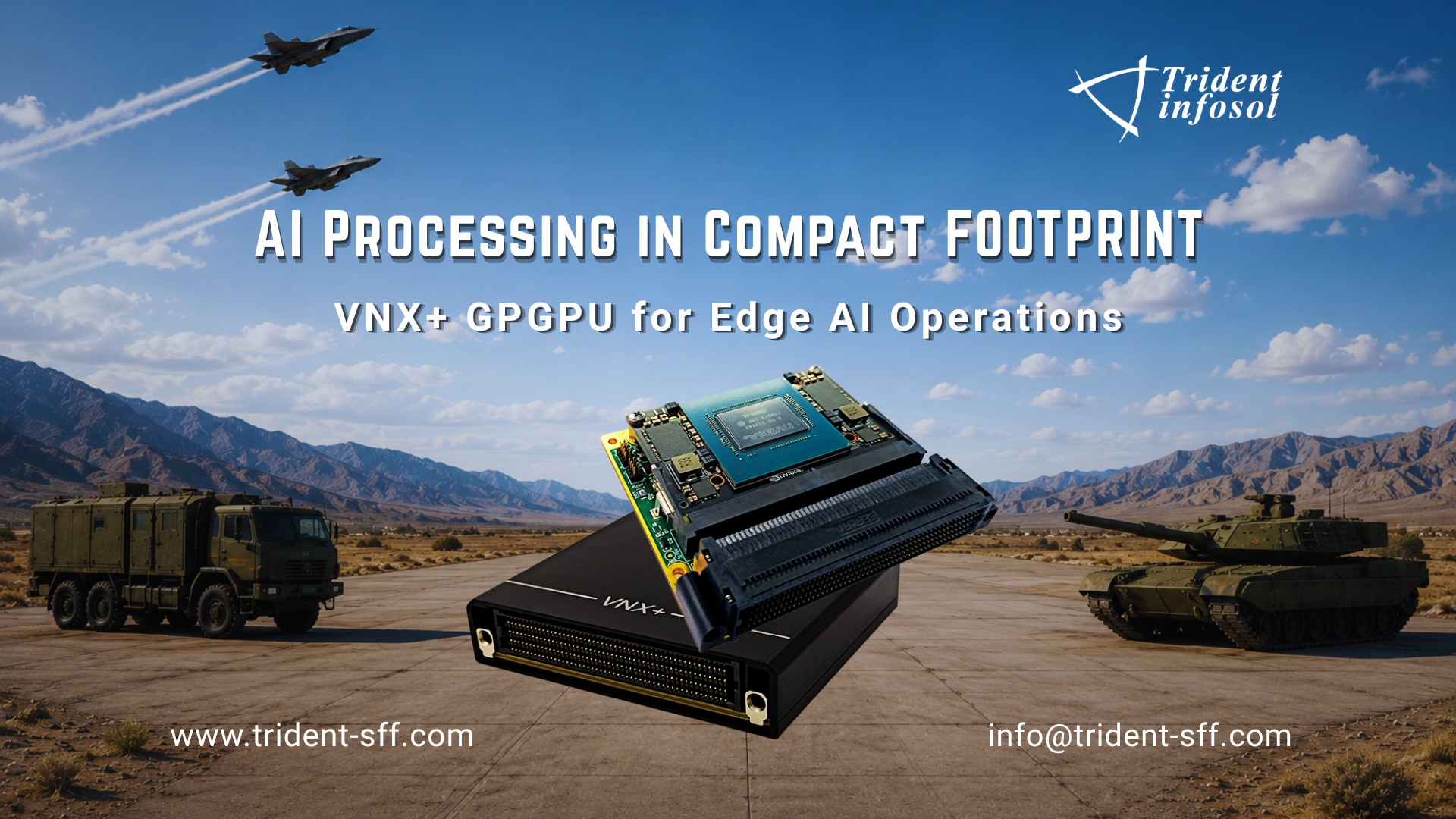
Edge AI in Defense: How VNX+ GPGPU Processors Are Transforming Rugged Systems
Modern defense platforms generate large volumes of data. Electro-optical and infrared cameras, synthetic aperture radar, LiDAR, electronic warfare receivers, and communications intercept systems produce data streams that must be processed in real time for actionable intelligence. Meeting these demands requires AI hardware capable of hundreds of Tera Operations Per Second (TOPS) while remaining within tight size, weight, and power (SWaP) constraints. This blog explores artificial intelligence inference and decision-making that happen in the tactical field, focusing on the GPGPU processors and modules that enable edge AI.
What Is Edge AI in Defense?
Edge AI refers to the deployment of Artificial Intelligence algorithms on hardware systems located at the source of data, rather than in centralized data centers. In a defense context, this means embedding AI processing into ground vehicles, unmanned aerial systems, airborne intelligence platforms, and shipborne command/control systems to reduce latency and dependence on data centers.
The Role of AI GPGPU Processors
Not all processors are built for AI workloads. General-purpose CPUs, while flexible, are not suitable for the high performance operations. This is where ANSI/VITA 90 VNX+ GPGPU modules optimized for AI come into play. These modules with AI processors combine hundreds or thousands of compute cores with specialized tensor processing cores that can handle heavy processing workloads faster than a CPU alone.
Why Rugged Systems Demand Specialized Hardware
Military and defense systems operate across extreme temperature ranges, high-vibration environments, and under strict electromagnetic compliance requirements. Hence, any AI hardware that is built for tactical deployment must be engineered from the ground up for resilience against unpredictable conditions and terrains.
The Importance of Conduction Cooling
Many embedded defense platforms cannot rely on fans or active airflow for thermal management. In sealed chassis, heat must be drawn away from the processor with conduction cooling. AI processors must therefore be engineered to meet conduction-cooled thermal demands without sacrificing compute performance.
Standards Compliance and System Integration
Interoperability is a cornerstone of defense systems engineering. Open architecture standards define the mechanical, electrical, and thermal interfaces that allow hardware from different manufacturers to integrate seamlessly into larger platform architectures. For embedded AI computing, compliance with recognized VNX+ standards is a critical criterion, ensuring that boards can be slotted into standard chassis and deployed alongside other mission computing components.
Key Considerations When Evaluating Embedded AI Hardware for Defense
1. Compute Architecture
The processors must have dedicated tensor or CUDA cores that accelerate workloads requiring AI processing.
2. Memory Bandwidth
AI processing is memory-intensive. Wide memory such as 16GB supports the high data throughput that AI operations demand.
3. Interface Richness
Mission computing boards must interface with various modules in the modular ecosystem. The availability of PCIe lanes, high-speed networking interfaces, and I/O options including display port, USB (2.0 & 3.2), GPIO, RS-232, and SGMII support missions that need a wide range of interface availability.
4. Operating Temperature Range
Military-grade hardware, like AI GPGPU modules should be validated for extended temperature operation, typically spanning at least -20°C to +85°C, to cover the range of environments encountered in deployed systems.
5. Standards Alignment
Aerospace and defense programs need to prioritize boards (GPGPUs) that comply with recognized open architecture standards for defense embedded computing, reducing integration risk and supporting long-term platform maintenance.
Conclusion
In conclusion, edge AI is no longer a future capability but operational necessity. AI GPGPU processors deployed in compact, conduction-cooled, standards-compliant form factors are the building blocks of this next generation computing at the tactical edge. As platforms evolve and AI models become more sophisticated, the hardware that carries them must evolve too, delivering more compute, at lower power, in smaller enclosures, under more extreme conditions.
Trident SFF designs and delivers AI embedded computing solutions engineered for the most demanding defense and aerospace applications.
Explore the VNX+ GPGPU computing module at www.trident-sff.com or reach out to our team at us-sales@trident-sff.com to discuss your platform requirements.