
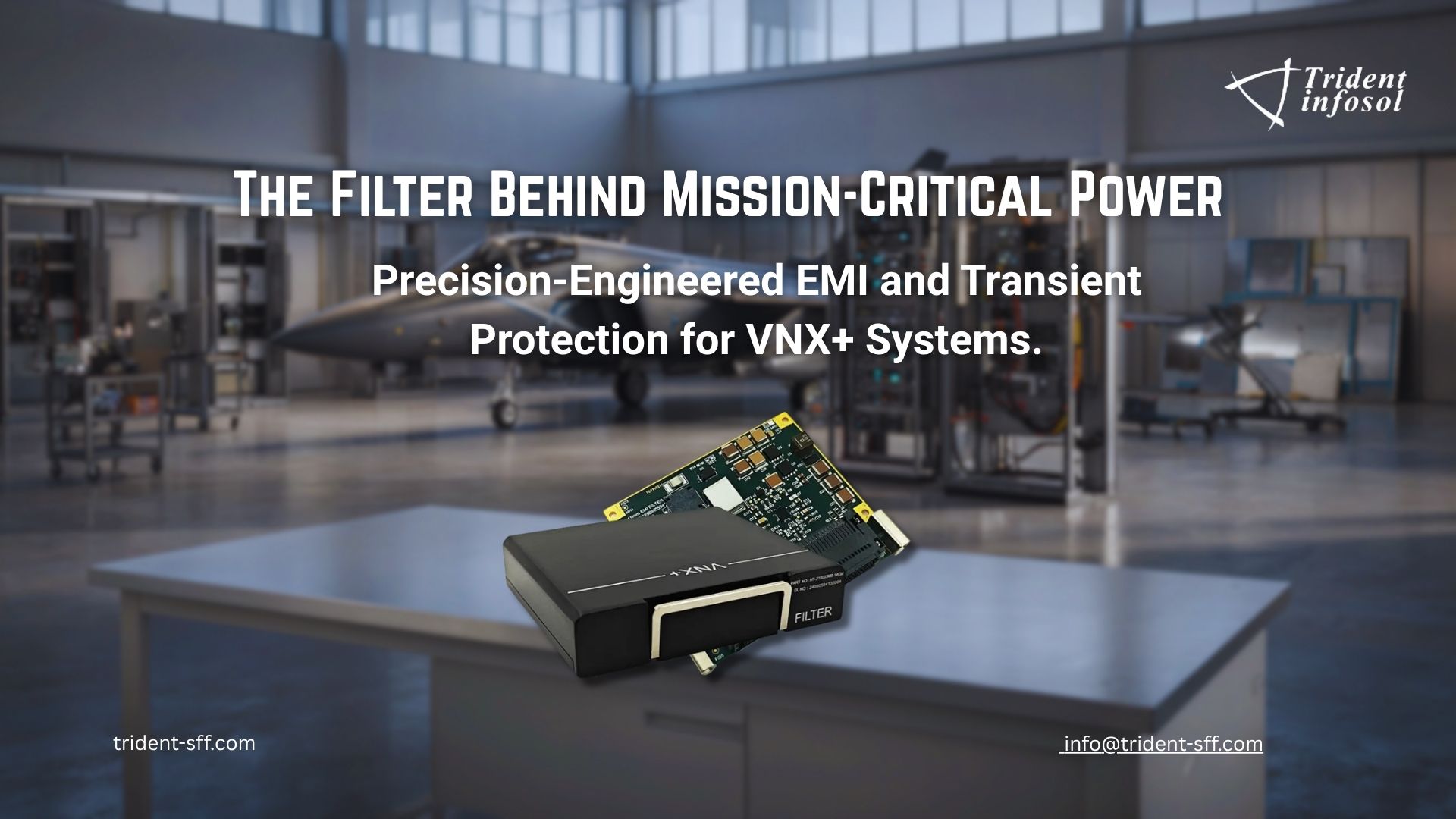
Power quality is one of those problems that engineers only think about after something has already gone wrong. In rugged and mission-critical systems, a voltage spike or a burst of electromagnetic noise on the DC bus can corrupt data, trip protection circuits, or degrade the life of downstream electronics. The fix isn’t usually a redesign of the power supply itself — it’s controlling what reaches it in the first place.
That’s the role of a PSU filter inside a VITA-based system like VNX+. Rather than asking every board in the chassis to tolerate dirty input power, a dedicated filtering stage sits ahead of the power supply units and conditions the incoming DC before it ever reaches sensitive electronics.
What Is the VNX+ EMI and Transient Filter?
This module is a PSU filter — a protective stage placed between the incoming DC power source and the power supply units of a VNX+ system. Its job isn’t to generate or regulate power; it’s to clean it up before it gets used.
Inside a chassis, the power supply units are what everything else depends on. If they receive noisy or unstable input, that instability can ripple downstream into compute, storage, and I/O boards. By intercepting noise and transients at the input stage, this filter acts as a barrier that keeps the rest of the system’s electronics operating on a stable, predictable supply.
It’s built to the VITA 90.3 standard, which places it within the broader ecosystem of VNX+ system architecture rather than as a standalone accessory.
Engineering Goals Behind the Design
The filter exists to solve a specific engineering problem: DC power in real-world deployments is rarely clean. Vehicles, aircraft, and industrial platforms generate electrical noise from switching loads, motors, and other equipment sharing the same power bus. Left unfiltered, that noise reaches the PSU and, from there, the rest of the system.
Engineers integrating a VNX+ platform need to account for:
- Electromagnetic interference entering through the DC input and coupling into sensitive circuits
- Voltage transients from load switching or abnormal bus conditions
- Reverse polarity connections, which can occur during installation or maintenance
- Overvoltage events that exceed the system’s normal operating range
- Wide input voltage swings, since supply rails in vehicles and aircraft are rarely a fixed, clean value
The filter is positioned to address all of these before power ever reaches the PSU, rather than requiring the PSU itself to absorb and tolerate them.
Key Capabilities at a Glance
| Capability | What It Covers |
| Noise filtering | Differential and common mode noise suppression on the DC input |
| Transient protection | Reverse voltage, transient, and over voltage protection circuits |
| Wide input range | Operates across 12VDC to 36VDC, with a 28VDC nominal rail |
| EMI/EMC compliance | Designed to meet MIL-STD-461 (D-G: CE102) |
| Transient standard compliance | Designed to meet MIL-STD-704F (Normal, Abnormal, RVP) |
| VITA alignment | Designed to VITA 90.3 , fitting the VNX+ system architecture |
| Mechanical footprint | 3.5 x 3.07 x 0.75 inches, approximately 0.55 lbs |
| Environmental range | -40°C to +85°C operating temperature |
Noise Filtering
The filter is designed to withstand EMI and remove both differential and common mode noise before power reaches the rest of the system. This noise suppression is part of what the filter is designed to meet MIL-STD-461 (D-G: CE102) for — a standard specifically concerned with conducted emissions on power lines. Addressing differential and common mode noise directly supports that compliance target, rather than leaving it to be handled elsewhere in the system.
Transient and Fault Protection
Beyond steady-state noise, DC buses are also exposed to transient events — short-duration spikes, reversed connections during installation, or supply conditions that briefly exceed normal limits. The filter includes dedicated protection circuits for handling these fault conditions, working alongside the noise-filtering stage.
This layered approach means a single fault condition — say, an engineer connecting power backward, or a transient spike from a nearby load — doesn’t have a direct path to the PSU. Each protection stage is handling a different category of fault before the filtered, protected DC output reaches the 320-pin connector.
Wide Input Voltage Range
The filter accepts a DC input range of 12VDC to 36VDC, with 28VDC as the nominal operating point. This range matters because many vehicle, aircraft, and industrial power buses don’t hold a fixed voltage — they fluctuate based on load, battery state, or generator output.
Designing the filter to accept this range rather than a single fixed voltage means it can sit in front of PSUs across a variety of platforms without requiring a separate front-end design for each supply condition.
EMI/EMC and Transient Standard Alignment
The filter is designed to meet MIL-STD-461 (D-G: CE102) for EMI/EMC, and MIL-STD-704F (Normal, Abnormal, RVP) for transient behavior. These are the standards that define how equipment should behave when subjected to conducted emissions and abnormal power bus conditions, respectively — categories that are especially relevant in defense and aerospace platforms where the power environment is far from ideal.
For a system architect specifying components for a defense or aerospace program, alignment with these standards is often a starting requirement rather than an optional feature. Having the filtering stage already designed against them simplifies qualification of the surrounding system.
VITA 90.3 Alignment
Designed to the VITA 90.3 standard, the filter is built to fit within the VNX+ system architecture rather than as a generic, standalone power filter. This matters for system architects because it means the module’s interface — the 320-pin Searay connector — and its role in the power path are defined against the same architecture the rest of the system is built on, rather than requiring custom integration work.
Compact, Rugged Mechanical Design
At 3.5 x 3.07 x 0.75 inches and roughly 0.55 lbs, the filter has a small footprint relative to the protection it provides. Combined with an operating temperature range of -40°C to +85°C, it’s built to sit inside a chassis that may see temperature extremes without becoming a thermal or space constraint of its own.
For integrators working with limited slot space in a VNX+ chassis, a compact filtering stage means power conditioning doesn’t come at the cost of usable system volume.
Applications
- Defense and military platforms — filtering DC input against noise and transients
- Aerospace systems — handling abnormal and transient power bus conditions
- Rugged, extreme-environment deployments — operating where standard filtering hardware isn’t rated to perform
What This VNX+ PSU Filter Solves
Filtering noise and transients at the power input is a structural design decision, not an afterthought. By handling EMI suppression and fault protection before power reaches the PSU, the rest of the VNX+ system doesn’t need to be individually ruggedized against every possible bus condition — the filtering stage absorbs that responsibility.
This also simplifies the integrator’s job. Instead of qualifying each downstream board against MIL-STD-461 and MIL-STD-704F independently, the power conditioning work is concentrated in a single, defined stage that’s already designed against those standards. That’s a meaningful reduction in integration complexity for teams building out a VNX+ system for a defense, aerospace, or industrial deployment.
The wide input range and VITA 90.3 alignment add flexibility on top of that: the same filtering module can support systems where input voltage isn’t fixed, without requiring a custom built module for each deployment.
Want to Add the Helios Filter to Your VNX+ System?
Contact our team to discuss your application and discover how our modular platforms can be configured to your exact operational needs info@trident-sff.com | www.trident-sff.com